Wednesday, November 30, 2016

Hamartia

Hamartia

Hamartia


Definition


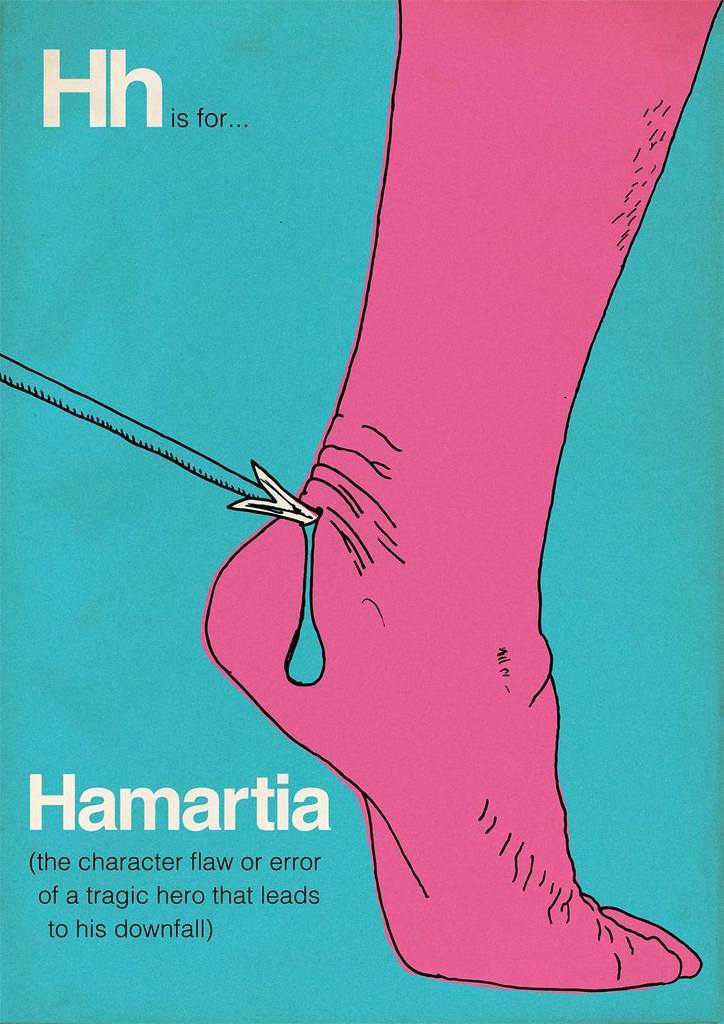
A fatal flaw of a character that leads to the downfall of that character.


Example- from Canterbury Tales


“I’ll up and put my dagger through his back

While you and he are struggling as in game;
Then draw your dagger too and do the same.
Then all the money will be ours to spend” (227-230)

“They fell on him and slew him, two to one.
Then said the first of them when this was done,
‘Now for a drink. Sit down and let's be merry
For later on there’ll be a corpse to bury.’
And, as it happened, reaching for a sup,
He took a bottle full of poison up
And drank; and his companion, nothing loth,
Drank from it also, and they perished both.”

Function

In the example of The Pardoner’s Tale the characters allow greed to overtake them which eventually leads to a twist that results in their death. Greed is the fatal flaw of the characters and it leads to the death of the characters, which is the downfall. This allows the reader to pity the characters because of the result, but it also allows the reader to learn from the characters mistakes so that he/she does not do the same in their life.

Another example


“‘Oh, you are indeed, my love’ said Sméagol; and he caught Déagol by the throat and strangled him, because the gold looked so bright and beautiful. Then he put the ring on his finger.” (Tolkien 52)


Non-original mnemonic

Original mnemonic

Harmful
And
Mean
Attributes are
Reasons
Towards
Inevitable
Atrophy

Friday, November 18, 2016

Cacophony

Cacophony


Definition

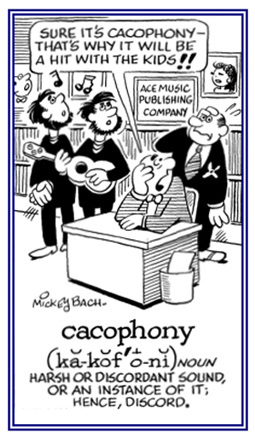
A situation in literature in where harsh and discordant sounds in words are used to create a hissing and/or unmelodious feeling to the text. Cacophony uses single consonants or combinations of consonants that require effort to deliver correctly.

Example- from Canterbury Tales

"And what Hippocrates and Rufus knew and Dioscorides, now dead and gone, Galen and Rahzes, Hali, Serapion, Averroes, Avicenna, Constantine, Scotch Bernard, John of Gaddesden, Gilbertine" (440-444).
"No quicksilver, lead ointments, tartar creams, Boracic, no, nor brimstone, so it seems, could make a salve that had the power to bite, clean up or cure his whelks of knobby white or purge the pimples sitting on he cheeks" (645-649).

Function

In the first example, the use of cacophony is quite basic. The many uses of the letters g, r, s, j, and the combination sc create a very unappealing sound to the reader that may end up creating a sense of brokenness to the text. The second example uses cacophony in a way that emphasizes the nastiness of the Summoner's blemishes. The use of cacophony makes the cures (Boracic and brimstone) sound very strong and powerful, yet they still can not clear up the Summoner's face.

Another example

"It came to the edge of the fire and the light faded as if a cloud had bent over it. Then with a rush it leaped across the fissure. The flames roared up to greet it, and wreathed about it; and a black smoke swirled in the air. Its streaming mane kindled, and blazed behind it. In its right hand was a blade like a stabbing tongue of fire; in its left it held a whip of many thongs" (Tolkien 320).

Non-original mnemonic


Original mnemonic

CAC-OPHONY sounds like a nasty cough and a sneeze mixed together. No one likes to hear coughing and sneezing.

Tuesday, November 15, 2016

Analogy

Analogy

DefinitionA comparison between two things, typically on the basis of their structure and for the purpose of explanation or clarification.

Example from Canterbury Tales

"I don't begrudge them their virginity;They're bread from the finest wheat, so be it said,And let us wives be known as barley bread." (143-145). (Unabridged).FunctionIn this example from The Wife of Bath's prologue in Canterbury Tales uses the analogy between a virgin and bread to explain that, in her opinion, a man values a virgin over a woman who has already been married before. In the time of Canterbury Tales, the finest wheat would be much more sought after than the regular barley bread that the peasants were accustomed to. The analogy makes it clear to the audience in more simple terms what the average medieval man thought, according to the Wife of Bath.Another Example"Even Frodo feared no danger yet, for they were still in the heart of the Shire." The Fellowship of the Ring (71). The phrase "heart of the Shire" refers to their location as centrally inside the Shire, as the heart is central in the body. The phrase is also an analogy regarding safety, as the heart is the most protected part of the body.Non-Original MnemonicCan be found here. Original MnemonicAn analogy is to writing, as paint is to a painting. 

Tuesday, November 8, 2016

Exemplum

Exemplum


Exemplum

Definition
An example, model, short tale, narrative, or anecdote used in literary pieces and speeches to explain a doctrine or emphasize a moral point. 
Example from Canterbury Tales
"He would allow-just for a quart of wine-
Any good lad to keep a concubine
A twelvemonth and dispense it altogether!
Yet he could pluck a finch to leave no feather:
And if he found no rascal with a maid
He would instruct him not to be afraid"
(665-670)

"The Pardoner's Tale" story

Function


In Chaucer’s The Canterbury Tales, the stories of “The Summoner” and “The Friar” being greedy and evil are a direct slam of the Catholic Church during the 14th century in Europe. Chaucer makes it clear that he is against the way the Church was operating. In The Pardoner's Tale, the exemplum is that greed is the most horrendous of all evils because all of the men who wanted the treasure ended up killing each other, thus showing that none of them were rewarded in the end.


Another example

A boy called out "Wolf!" to scare the local villagers, even though there was no wolf. He did this many times. One day, a wolf actually did come up to the boy, and he yelled "Wolf! Wolf!", but nobody came to help him, because they thought he was lying again. 

This is possibly the most famous exemplum of them all, along with the story of the tortoise and the hare. 
Non-original mnemonic

Original mnemonic

Posted by Andy Nuber

Thursday, October 27, 2016

Alliteration


 Alliteration

Definition

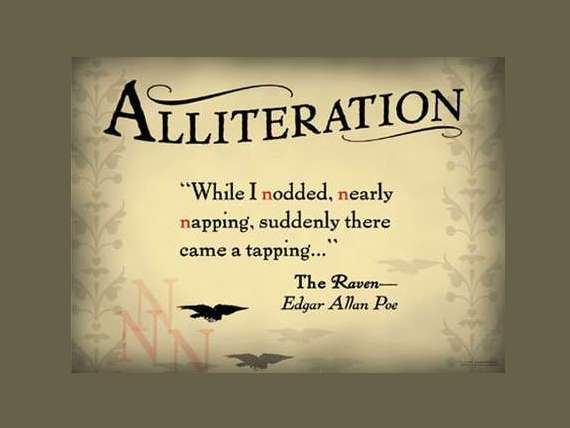
The occurrence of the same letter or sound at the beginning of adjacent or closely connected words.

Example from Canterbury Tales

"At meat her manners were well-taught withal,;
No morsel from her lips did she let fall," 
(65)

Function

In this excerpt from Canterbury Tales, the repetition of the /m/ sound in "meat her manners" and the /w/ sound in "were well-taught withal" create an overall flow and make the text easier and more enjoyable to read. The use of alliteration creates a musical effect and makes the text more attractive and appealing. In general, it provides emphasis on a particular point being made or makes some aspect of the work more memorable.

Another example

"'Don't lie to me,' Myrtle gasped, tears now flooding down her face, while Peeves chuckled happily over her shoulder. 'D'you think I don't know what people call me behind my back? Fat Myrtle! Ugly Myrtle! Miserable, moaning, moping Myrtle!'" 

                                                        -Harry Potter and the Chamber of Secrets, J.K. Rowling

Non-original mnemonic

Original mnemonic

Alliterations Are Always Appealing, Attractive, And Awesome!

Posted by Your Renee Lemke

Tuesday, October 25, 2016

Anaphora

Anaphora

Definition 

The deliberate repetition of the first part of a sentence in order to achieve an artistic effect

Example from Canterbury Tales

“O cursed sin! O blackguardly excess!

O treacherous homicide! O wickedness!
O gluttony that lusted on and diced!
O blasphemy that took the name of Christ”
(347-350)

Function

In these lines from Canterbury Tales, the repetition of the word O is used to draw attention and give prominence to the terrible sins that eventually led to the death of Christ. Phrases with anaphora tend to be short and pointed for dramatic emphasis. In general, anaphora is used both to emphasize ideas and add rhythm to literature, which makes the text more enjoyable to read and easier to remember. In writing it provides an artistic effect; in speech it can be used as a persuasive tactic or emotional appeal.

Another example 

“It was the best of times, it was the worst of times, it was the age of wisdom, it was the age of foolishness, it was the epoch of belief, it was the epoch of incredulity, it was the season of Light, it was the season of Darkness, it was the spring of hope, it was the winter of despair.”

-Great Expectations, Charles Dickens

Non-original mnemonic

Original mnemonic

Wednesday, October 12, 2016

Omniscient

Omniscient

Image result for omniscient

Definition

To be omniscient is to know everything. In literature, an omniscient point of view or narration is one in which the narrator knows the thoughts and actions of every character in the narrative. This is called third person omniscient, and was arguably the most popular point of view in novels until the twentieth and twenty-first centuries. A third person omniscient narrator can freely jump between different characters’ minds, either in different chapters or even in the same scene. This creates a sense that the narrator is godlike and creates some trust that the narrator is objective and telling the truth. However, it can also be jolting to see into different characters’ thoughts in quick succession.

Example – from Mary Barton

‘How dare you say he shot Mr. Harry?’ “asked Mary, firing up from the state of languid indifference into which she had sunk while Sally had been settling about her dress.”  ‘But it’s no matter what you think, as did not know him. What grieves me is, that people should go on thinking him guilty as did know him,’ “she said, sinking back into her former depressed tone and manner.”
‘And don’t you think he did it?’ asked Sally (Gaskell 276).”

Function

The narrator of "Mary Barton" takes the third person omniscient form, in which the narrator is all-knowing and all-seeing. This narrator knows the thoughts of all the characters, notwithstanding their class. For example, “Mary went very red, and looked annoyed, although there was a secret spring of joy deep down in her heart, at hearing Jem so spoken of.” Her narration is full of pity and sympathy as she anguishes over the great divide between the lower and upper class. The narrator also attempts to present the classes authentically, as she records the local dialect of the working class.

Another example

“You are a slow learner, Winston."
"How can I help it? How can I help but see what is in front of my eyes? Two and two arfour."
"Sometimes, Winston. Sometimes they are five. Sometimes they are three. Sometimes they are all of them at once. You must try harder. It is not easy to become sane.”   
- George Orwell’s 1984

Non-original mnemonic


Original mnemonic

O- Old
M- Mr.
N- Nauman
I- Is
S- Smart
C- (and) clever
I- In
E- Everything
N- Not

T- Told