Monday, December 19, 2016

Anastrophe

Anastrophe


Definition
A literary device in which the normal order of words is reversed in order to achieve a particular effect of emphasis or meter.


Example from The Two Towers

“Like a deer he sprang away. Through the trees he sped. On and on he led them, tireless and swift, now that his mind was at last made up” (410).


Function
In this example anastrophe is used to bring attention to how fast they were when searching for the others. Tolkien switches the order of the verb and subject to emphasize the verbs in the sentence.


Another Example
Middle Eastern Anastrophe
by Ramsey Collins

Love you they don’t.
Kill you they will.
Hear us they won’t.
Old holes be filled.


Freedom you want.
Fetters they like.
On be the hunt.
Long be the hike.

Non-Original Mnemonic 

can be found here

Origianl Mnemonic

From this, I have learned a lot


Wednesday, December 14, 2016

Euphemism

Euphemism


Image result for Euphemism

Definition


A polite, indirect expression which replaces words and phrases considered harsh and impolite or which suggest something unpleasant.


Example- from Jane Eyre


“She kissed me, and I her, and we both soon slumbered.” (59)

Function

In the example from Jane Eyre, euphemism is used rarely and subtly. The line above is referring to when Helen was on her deathbed and Jane was lying with her. They were saying goodnight to each other, which also was their goodbye. In Jane’s narration above, the word “slumbered” referred to Helen passing away, it is a euphemism for her death. Charlotte Bronte used a euphemism here to indirectly talk about Helen’s death and add a more artistic element to the text.

Another example


“You know the truth, and the truth is this: some Negroes lie, some Negroes are immoral, some Negro men are not to be trusted around women—black or white. But this is a truth that applies to the human race and to no particular race of men. There is not a person in this courtroom who has never told a lie, who has never done an immoral thing, and there is no man living who has never looked upon a woman without desire.” Harper Lee wrote that Atticus Finch used the euphemism “Negro” to refer to a race of people and although that is historically accurate, a modern-day Atticus Finch would use the more currently accepted euphemism of “African-American” to refer to this race of people. 

Non-original mnemonic
Can be found here


Original mnemonic


Eu (you) phemism (feminism)
Are you a feminist?
Instead, you could ask: Are you in favor of women’s rights? It sounds less harsh on that topic in today’s society.

Tuesday, December 6, 2016

Chiasmus


Image result for chiasmus example

Definition


a rhetorical or literary figure in which words, grammatical constructions, or concepts are repeated in reverse order, in the same or a modified form


Example- from Jane Eyre


“At last coffee is brought in, and the gentlemen are summoned” and “Where is Mr Rochester? He comes in last” (165).

Function

In the example from Jane Eyre chiasmus is used very subtly. In it the word “last” is used in both quotes, but it comes in different parts of the clauses. This adds an artistic effect to Charlotte Bronte’s work by balancing the two clauses against each other.
Another example

“I meant what I said, and I said what I meant.” In this example from Dr. Seuss’ Horton Hatches the Egg, the elephant, Horton, was explaining through a chiasmus that he meant what he said in a more artistic way.

Non-original mnemonic

Can be found here

Original mnemonic

C- chiasmus
H- helps
I- in 
A- applying
S- stylish (and)
M - multiple
U- uses (in)
S- stories

Wednesday, November 30, 2016

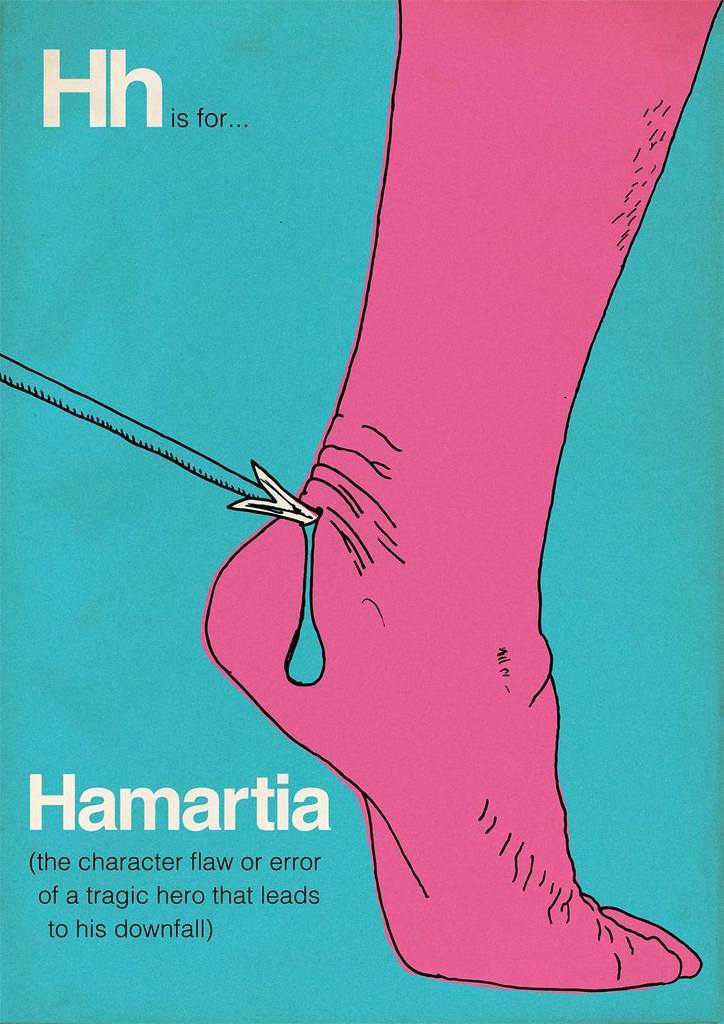
Hamartia

Hamartia

Hamartia


Definition


A fatal flaw of a character that leads to the downfall of that character.


Example- from Canterbury Tales


“I’ll up and put my dagger through his back

While you and he are struggling as in game;
Then draw your dagger too and do the same.
Then all the money will be ours to spend” (227-230)

“They fell on him and slew him, two to one.
Then said the first of them when this was done,
‘Now for a drink. Sit down and let's be merry
For later on there’ll be a corpse to bury.’
And, as it happened, reaching for a sup,
He took a bottle full of poison up
And drank; and his companion, nothing loth,
Drank from it also, and they perished both.”

Function

In the example of The Pardoner’s Tale the characters allow greed to overtake them which eventually leads to a twist that results in their death. Greed is the fatal flaw of the characters and it leads to the death of the characters, which is the downfall. This allows the reader to pity the characters because of the result, but it also allows the reader to learn from the characters mistakes so that he/she does not do the same in their life.

Another example


“‘Oh, you are indeed, my love’ said Sméagol; and he caught Déagol by the throat and strangled him, because the gold looked so bright and beautiful. Then he put the ring on his finger.” (Tolkien 52)


Non-original mnemonic


Original mnemonic

Harmful
And
Mean
Attributes are
Reasons
Towards
Inevitable
Atrophy

Friday, November 18, 2016

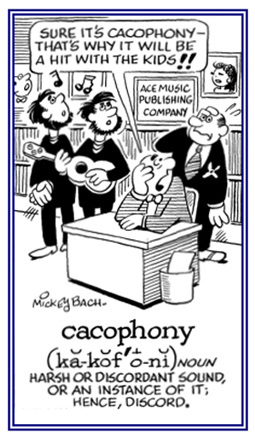
Cacophony

Cacophony


Definition

A situation in literature in where harsh and discordant sounds in words are used to create a hissing and/or unmelodious feeling to the text. Cacophony uses single consonants or combinations of consonants that require effort to deliver correctly.

Example- from Canterbury Tales

"And what Hippocrates and Rufus knew and Dioscorides, now dead and gone, Galen and Rahzes, Hali, Serapion, Averroes, Avicenna, Constantine, Scotch Bernard, John of Gaddesden, Gilbertine" (440-444).
"No quicksilver, lead ointments, tartar creams, Boracic, no, nor brimstone, so it seems, could make a salve that had the power to bite, clean up or cure his whelks of knobby white or purge the pimples sitting on he cheeks" (645-649).

Function

In the first example, the use of cacophony is quite basic. The many uses of the letters g, r, s, j, and the combination sc create a very unappealing sound to the reader that may end up creating a sense of brokenness to the text. The second example uses cacophony in a way that emphasizes the nastiness of the Summoner's blemishes. The use of cacophony makes the cures (Boracic and brimstone) sound very strong and powerful, yet they still can not clear up the Summoner's face.

Another example

"It came to the edge of the fire and the light faded as if a cloud had bent over it. Then with a rush it leaped across the fissure. The flames roared up to greet it, and wreathed about it; and a black smoke swirled in the air. Its streaming mane kindled, and blazed behind it. In its right hand was a blade like a stabbing tongue of fire; in its left it held a whip of many thongs" (Tolkien 320).

Non-original mnemonic


Original mnemonic

CAC-OPHONY sounds like a nasty cough and a sneeze mixed together. No one likes to hear coughing and sneezing.

Tuesday, November 15, 2016

Analogy

Analogy

DefinitionA comparison between two things, typically on the basis of their structure and for the purpose of explanation or clarification.

Example from Canterbury Tales

"I don't begrudge them their virginity;They're bread from the finest wheat, so be it said,And let us wives be known as barley bread." (143-145). (Unabridged).FunctionIn this example from The Wife of Bath's prologue in Canterbury Tales uses the analogy between a virgin and bread to explain that, in her opinion, a man values a virgin over a woman who has already been married before. In the time of Canterbury Tales, the finest wheat would be much more sought after than the regular barley bread that the peasants were accustomed to. The analogy makes it clear to the audience in more simple terms what the average medieval man thought, according to the Wife of Bath.Another Example"Even Frodo feared no danger yet, for they were still in the heart of the Shire." The Fellowship of the Ring (71). The phrase "heart of the Shire" refers to their location as centrally inside the Shire, as the heart is central in the body. The phrase is also an analogy regarding safety, as the heart is the most protected part of the body.Non-Original MnemonicCan be found here. Original MnemonicAn analogy is to writing, as paint is to a painting. 

Tuesday, November 8, 2016

Exemplum

Exemplum


Exemplum

Definition
An example, model, short tale, narrative, or anecdote used in literary pieces and speeches to explain a doctrine or emphasize a moral point. 
Example from Canterbury Tales
"He would allow-just for a quart of wine-
Any good lad to keep a concubine
A twelvemonth and dispense it altogether!
Yet he could pluck a finch to leave no feather:
And if he found no rascal with a maid
He would instruct him not to be afraid"
(665-670)

"The Pardoner's Tale" story

Function


In Chaucer’s The Canterbury Tales, the stories of “The Summoner” and “The Friar” being greedy and evil are a direct slam of the Catholic Church during the 14th century in Europe. Chaucer makes it clear that he is against the way the Church was operating. In The Pardoner's Tale, the exemplum is that greed is the most horrendous of all evils because all of the men who wanted the treasure ended up killing each other, thus showing that none of them were rewarded in the end.


Another example

A boy called out "Wolf!" to scare the local villagers, even though there was no wolf. He did this many times. One day, a wolf actually did come up to the boy, and he yelled "Wolf! Wolf!", but nobody came to help him, because they thought he was lying again. 

This is possibly the most famous exemplum of them all, along with the story of the tortoise and the hare. 
Non-original mnemonic

Original mnemonic

Posted by Andy Nuber